
Some thermal applications require cables far longer than the standard two-meter cable, and in exceptionally long runs (applications up to 35 meters), several questions arise:
- How long can the cable be?
- How much voltage loss can I expect?
- Will it impact my sensor readings?
The purpose of this application note is to answer these questions specifically for temperature control applications.
Laser diode applications have similar questions, but add additional questions not covered in this application note. Contact the factory if you are looking for long laser control cables.
How Long Can the Cable Be?
So long as the cable is shielded, the conductors are in twisted pairs to minimize inductance, and wires are of sufficient gauge to carry the current, there is no hard limit to the length of the cable. However, limitations of cable resistance do impose practical limitations on how long the cable can be. Arroyo Instruments has provided cables as long as 50 meters which have been used successfully in customer applications.
How Much Voltage Loss Can I Expect?
When considering voltage loss, this is typically in the high current drive for the Peltier element (TEC) and is the focus of this question.
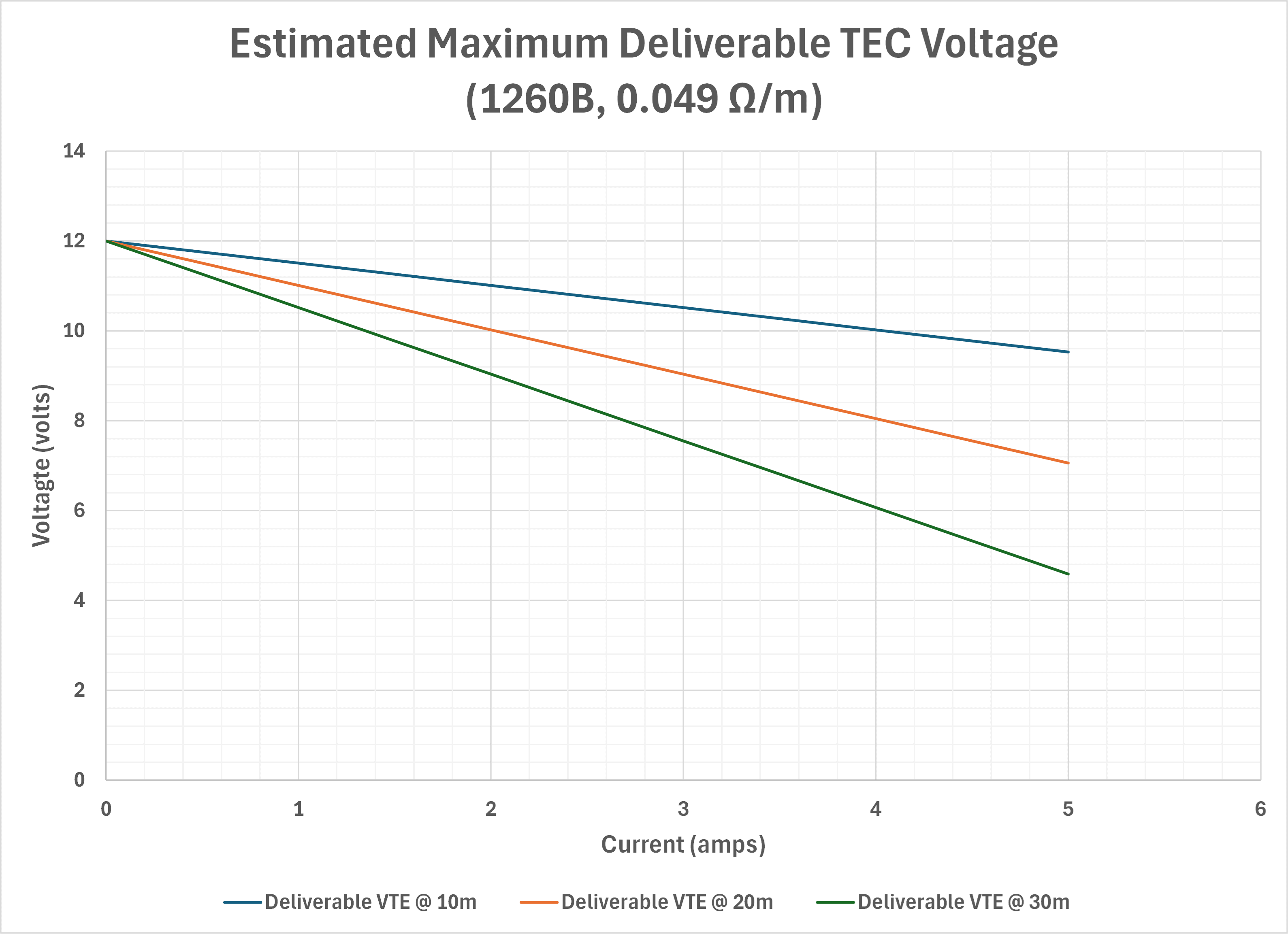
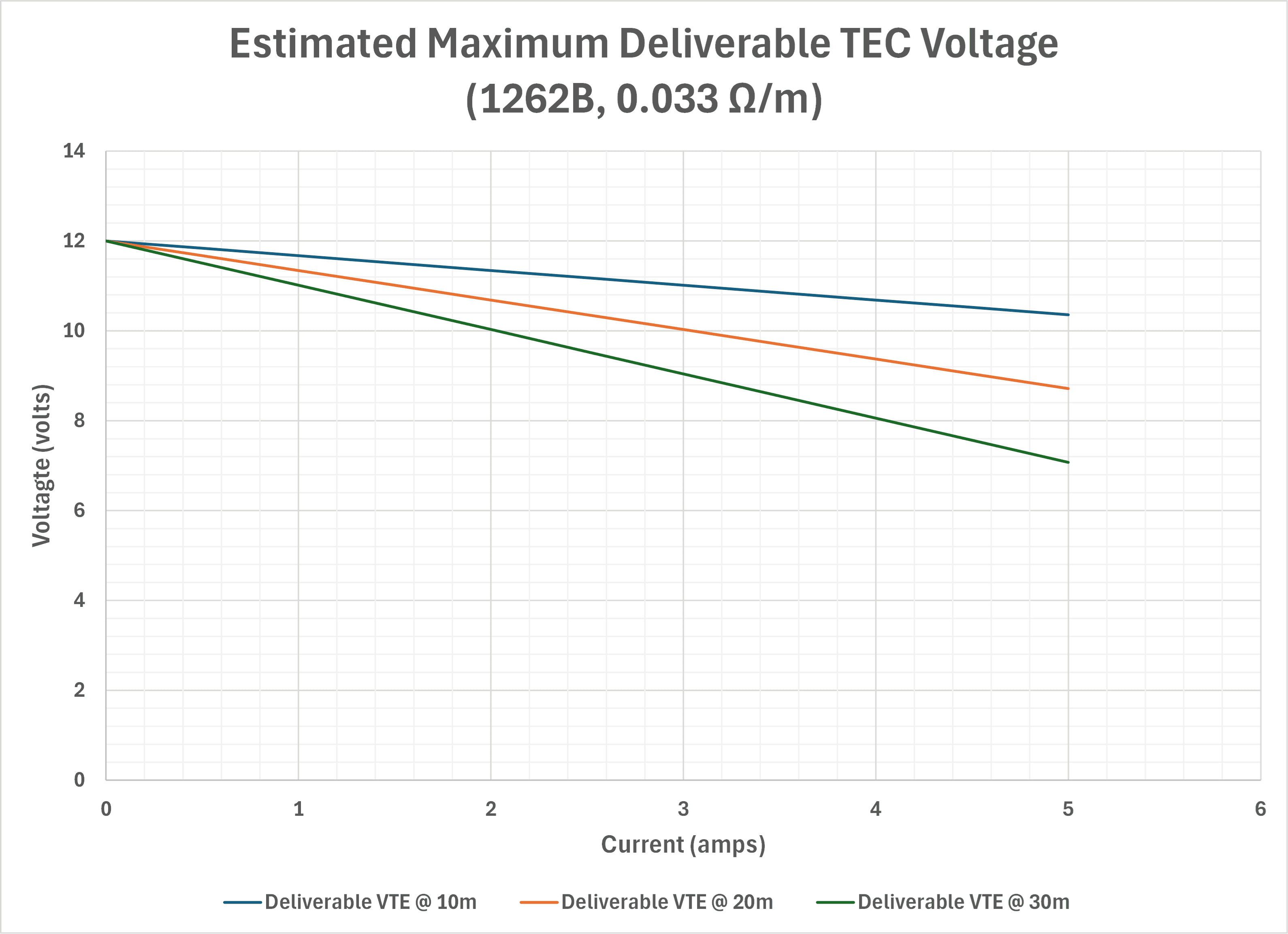
The 1260B and 1262B have approximately the following resistance as a function of length:
| Cable | Resistance |
|---|---|
| 1260B | 0.049 Ω/m |
| 1262B | 0.033 Ω/m |
The lower cable resistance of the 1262B (as compared to the 1260B) is achieved by using three 20 AWG wires in parallel instead of two pairs.
The following two graphs illustrate the maximum deliverable TEC voltage when using a 5305, which can supply 5A and 12V. Other controllers with different output capabilities will have similar but different graphs.
Will It Impact My Sensor Readings?
Depending on the sensor type, the extra length can have little (or even zero) impact or can significantly affect the measured temperature.
The general performance of the various sensors can be summed up as follows:
| Sensor | Performance Rating |
|---|---|
| Thermistor | Good |
| RTD 2-wire | Poor |
| RTD 4-wire | Excellent |
| LM335 | Fair |
| AD590 | Excellent |
As further illustration, each of the sensor types was tested with a 35-meter cable and the resulting performance is described in detail below:
Thermistor
The extra cable length added about 6Ω to the thermistor measurement, which is typically negligible except when operating at higher temperatures. For example, at 25°C on a 10kΩ thermistor, a 6Ω change causes a 0.014°C reduction in measured temperature, well below most system tolerances.
RTD
RTDs, when used in a 2-wire configuration, are significantly impacted by the additional cable resistance. For a typical 100Ω RTD, the additional 6Ω cable resistance increases the measured temperature by a whopping 15 degrees. This is due to the low resistance of the RTD sensor and the small increase in resistance as a function of temperature. However, by using the RTD with 4-wire sensing (supported by all Arroyo Instruments controllers that support RTDs), the impact of the cable resistance is eliminated.
LM335
Because the LM335 uses a 1mA constant current bias, the additional 6Ω cable resistance introduced a 6mV error in the measurement. Considering that typical LM335 sensors read out in 10mV/°C resolution, that translates into a 0.6°C error. While it is possible to software compensate for the error, one would be best advised to avoid the LM335 sensor when using long cable runs in systems that require good accuracy.
AD590
Similar to the LM335, but working as a current device instead of a voltage device, the AD590 produces current at a resolution of 1μA/°C. Because the AD590 can operate accurately across a range of bias voltages, a small reduction in bias voltage due to voltage losses in the cable will not adversely affect the measurement readout.
Conclusion
Other than the higher TEC voltage, if an appropriate sensor is selected, there should be no problems operating with long temperature controller cables. The resistance can introduce a notable voltage drop at higher currents, so if that is going to adversely affect your application, you may need to consider either going to cables with a heavier wire gauge, or a controller with higher output voltage. For example, a 5400-15-28 controller is capable of delivering up to 15 Amps and 28 Volts. Other current and voltage combinations are available, and likely can fit your application.
Click Here to Download the Application Note