| Model | Power | Current | Voltage | Stability | Sensors |
|---|---|---|---|---|---|
| 585-05-12 TECPak, 5A/12V | 55 W | 5 A | 12 V | ±0.004°C | Thermistor, RTD |
| 585-04-08 TECPak, 4A/8V | 32 W | 4 A | 8 V | ±0.004°C | Thermistor, RTD |

Power Ranges
Works With
Heat & Cool
Save Space
Remote Operation via PC
| Model | Power | Current | Voltage | Stability | Sensors |
|---|---|---|---|---|---|
| 585-05-12 TECPak, 5A/12V | 55 W | 5 A | 12 V | ±0.004°C | Thermistor, RTD |
| 585-04-08 TECPak, 4A/8V | 32 W | 4 A | 8 V | ±0.004°C | Thermistor, RTD |
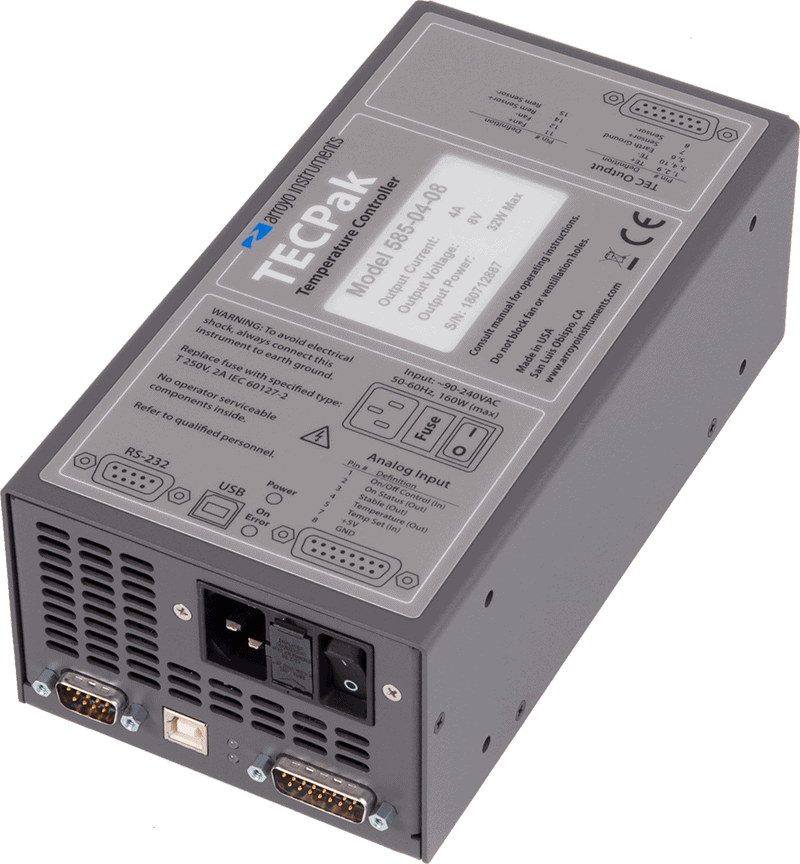
The TECPak temperature controller is a compact, high-power temperature controller that works on its own or together with a LaserPak to form a complete laser system.
The TECPak offers the same quality instrumentation as our benchtop units in a smaller, lower-cost solution for custom systems. In addition to both USB and RS-232 ports, the TECPak adds an analog control interface not found on the TECSource, allowing operation without the need for a computer.

The 585 offers ± 0.004ºC temperature stability over 1 hour, and only ± 0.01ºC fluctuation over 24 hours.

The 585 series automatically calculates PID parameters for your mount.

Every TECPak has eight factory-set gain settings, along with theoption to choose your own.

Provides on/off control, status, and analog control and monitor of temperature.

Provides integrated supply to power a laser mount cooling fan.
Arroyo Instruments temperature controllers feature bipolar current output, allowing for heating and cooling applications. All Arroyo Instruments temperature controllers, including the OEM packaged 585 and 586 Series TECPak controllers, provide heating and cooling capabilities.
Yes, Arroyo Instruments TEC controllers offer both low and high temperature set point limits, as well as the ability to fine-tune the controller’s PID parameters. PID parameters can be adjusted using eight standard factory gain settings that are numbered 1 through 300. Increasing the controller’s gain value will increase the speed of your control loop, while a rapid temperature fluctuation can be fixed by reducing the gain value. Users may need to experiment with a few different factory gain values to find the ideal value, and the gain can also be set to PID for even finer tuning. The PID parameters can also be set via the AutoTune Function, where the controller calculates ideal PID values based on your typical operating conditions. Please refer to your temperature controller’s user manual for more information and guidance for starting the Autotune feature.
Yes, most models support USB and RS-232 connections, with a select few models supporting Ethernet. Both the Arroyo benchtop and OEM temperature controllers can be controlled remotely via the ArroyoControl software, or integrated into custom systems using software such as LabVIEW, Python, and MATLAB.
The 585 and 586 Series TECPak temperature controllers are designed for compact, custom systems, and support PC-based control via USB and RS-232 communication interfaces. Both the 585 and 586 can be mounted in a standard 19 inch rack, and the 585 Series TECPak also includes an analog interface.
The TECPak Series controllers feature bipolar output capability like the rest of the Arroyo Instruments temperature controller selection. The 585 and 586 Series support NTC thermistors and 2 and 4-wire RTDs, while the 586 Series also supports LM335 sensors.
The Arroyo Instruments line of temperature controllers was designed for precision temperature control across a broad range of applications. Common applications and testing environments are laboratory/university research work, laser diode characterization, industrial and manufacturing testing applications, and OEM system integration.
Arroyo Instruments temperature controllers have a temperature stability specification of ±0.004°C over a 1 hour span and ±0.01°C over 24 hours at an ambient room temperature of roughly 25°C.